Subject Curriculum
In Business, our vision is:
To provide students with opportunities through an ambitious business curriculum which will nurture and inspire the next KSI, Alan Sugar or Deborah Meaden.
Curriculum Aim
At Beechwood School, in Business our curriculum aim is to support our students on their learning journey that will equip them to be future entrepreneurs and business leaders with the knowledge, understanding and skills needed for the dynamic modern business world.
Curriculum Intent
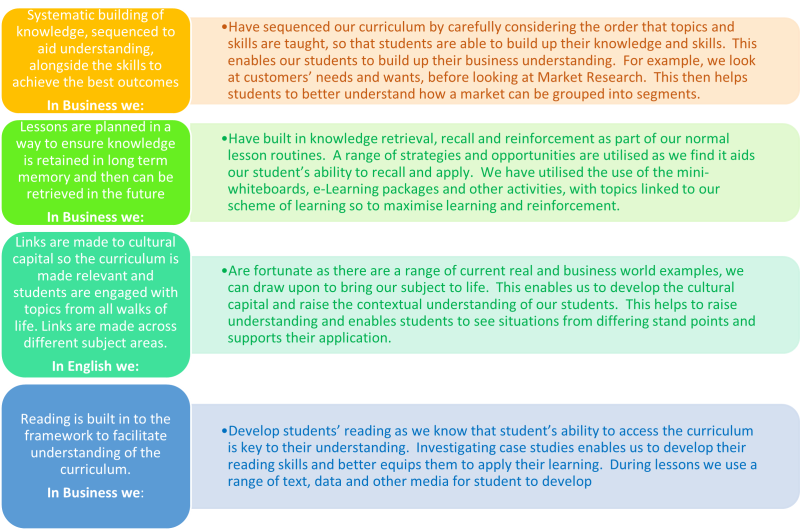
In Business we meet the curriculum aims of the school by…..
Curriculum Implementation
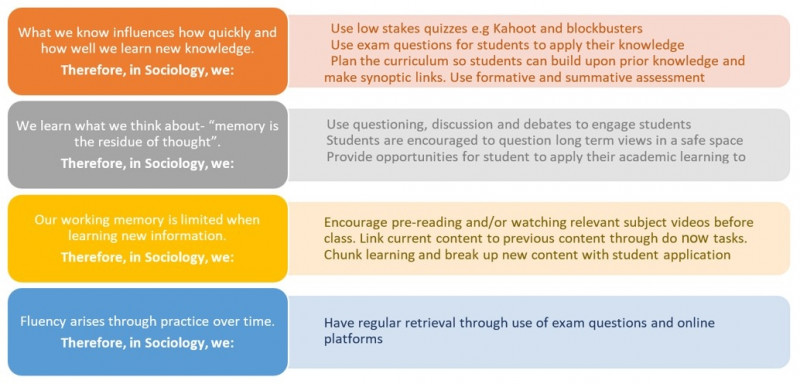
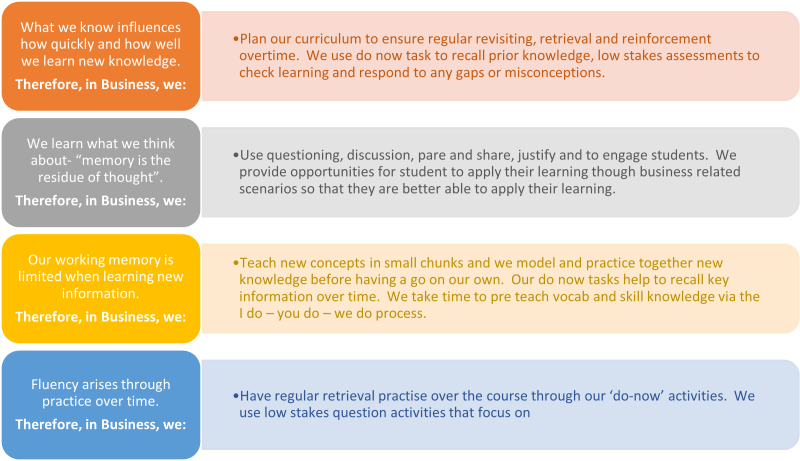
At Beechwood, our curriculum implementation is built on these 4 principles from cognitive science.
In Computer Science our vision is:
To provide a high-quality education for our students, and equipping them with knowledge, confidence and the skills in computer science and preparing them to take up real-world challenges in the future.
Curriculum Aim
At Beechwood School, in Computer Science our curriculum aim is two-fold: to inspire students as the pioneers of the future and to nurture a love of this subject. As computer programs pervade every aspect of our lives, our society needs computer scientists in every aspect of life. We aspire to nurture passionate individuals that will develop computing in every type of industry and every walk of life.
Curriculum Intent
In Computer Science we meet the curriculum aims of the school by enabling out students to see the wider picture and to relate their learning to the real world and possible career paths. Our intent is to help them become digitally literate, and digitally resilient. We will achieve this by teaching them to understand and apply the fundamental principles and concepts of Computer Science. They will acquire this knowledge by learning key facts and words, by analysing problems in computational terms, and through repeated practical experience of writing computer programs in order to solve problems. Students will learn to think creatively, innovatively, analytically, logically, critically to evaluate and apply information technology (including unfamiliar technologies). Students will become competent and creative users of computing– in both home and in future pathways of work contexts.
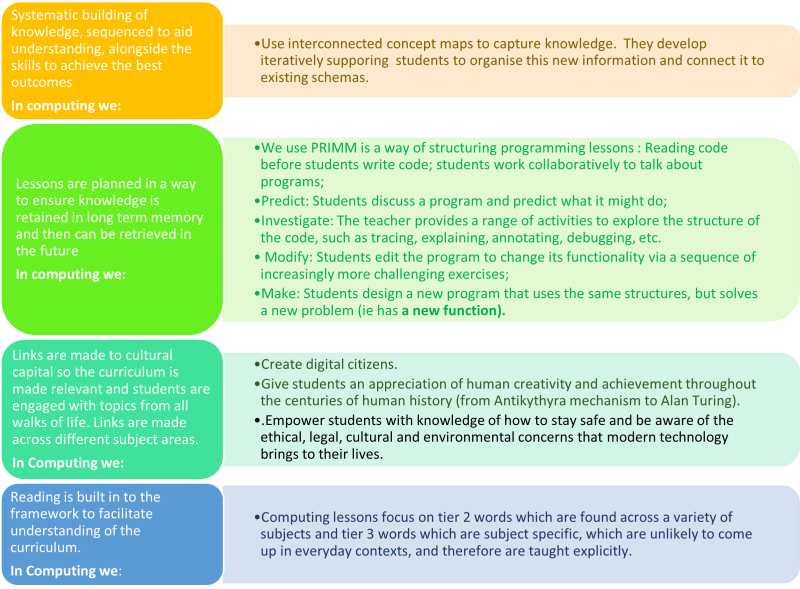
Curriculum Implementation
At Beechwood, our curriculum implementation is built on these 4 principles from cognitive science.
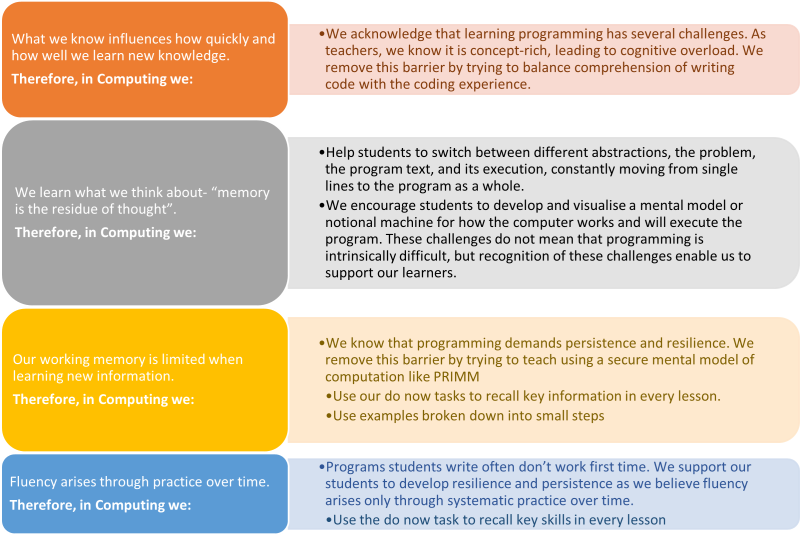
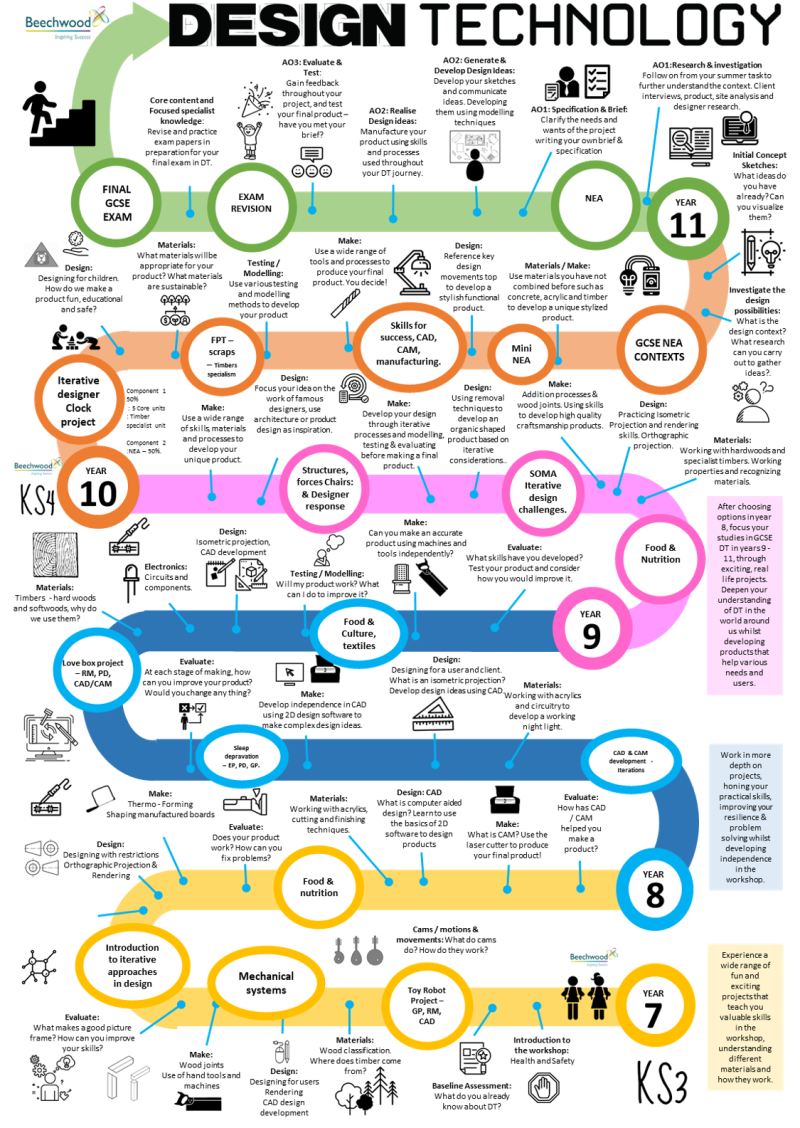
In Design & Technology, our vision is:
To support students to blend academic and creative knowledge enabling students to become outstanding design and technologists who are equipped to succeed through Excellence, Respect and Kindness.
Curriculum Aim
At Beechwood School, in design & technology, our curriculum aim is to give our young people the skills and abilities to engage positively with the designed and made world and to harness the benefits of technology in a sustainable way. They learn how products and systems are designed and manufactured, how to be innovative and to make creative use of a variety of resources including digital technologies and food & nutrition, to improve the world around them.
Curriculum Intent
In design technology we meet the curriculum aims of the school by…
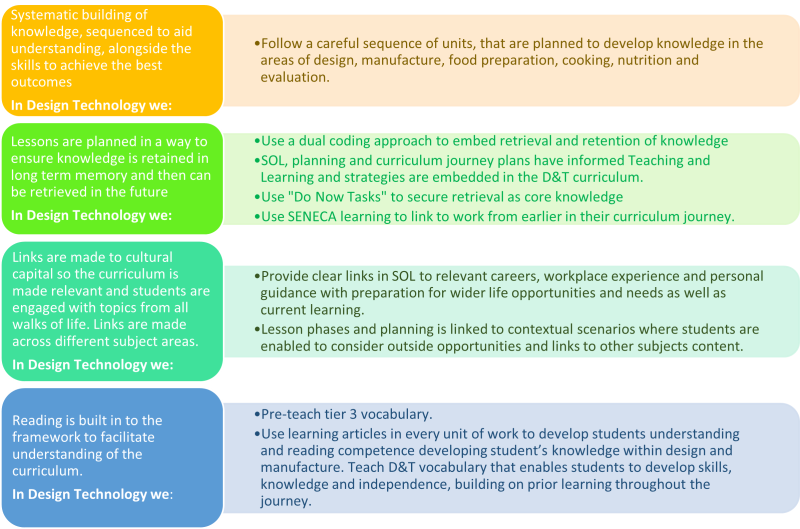
Curriculum Implementation
At Beechwood, our curriculum implementation is built on these 4 principles from cognitive science.
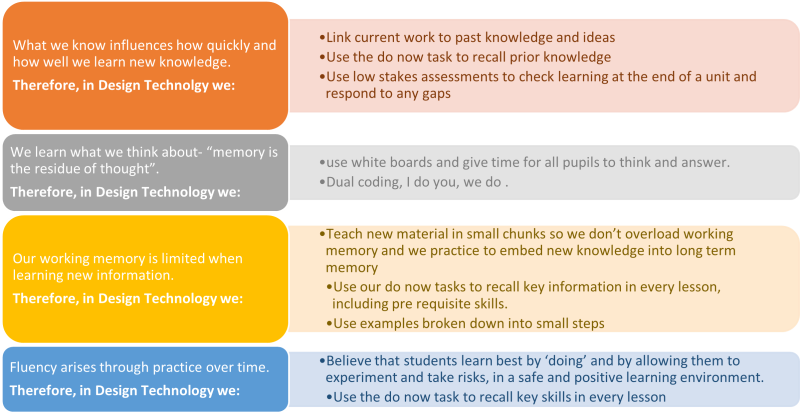
In Drama, our vision is:
To create a safe, happy, inspiring learning environment encouraging and enabling all students to develop an understanding of both themselves and the world they live in.
Curriculum Aim
In Drama, our curriculum aim is to enable students to have the knowledge, skills and vocabulary related to Drama. This will give them the ability to manipulate the drama medium effectively and independently appropriate to different audiences, purposes and contexts.
Curriculum Intent
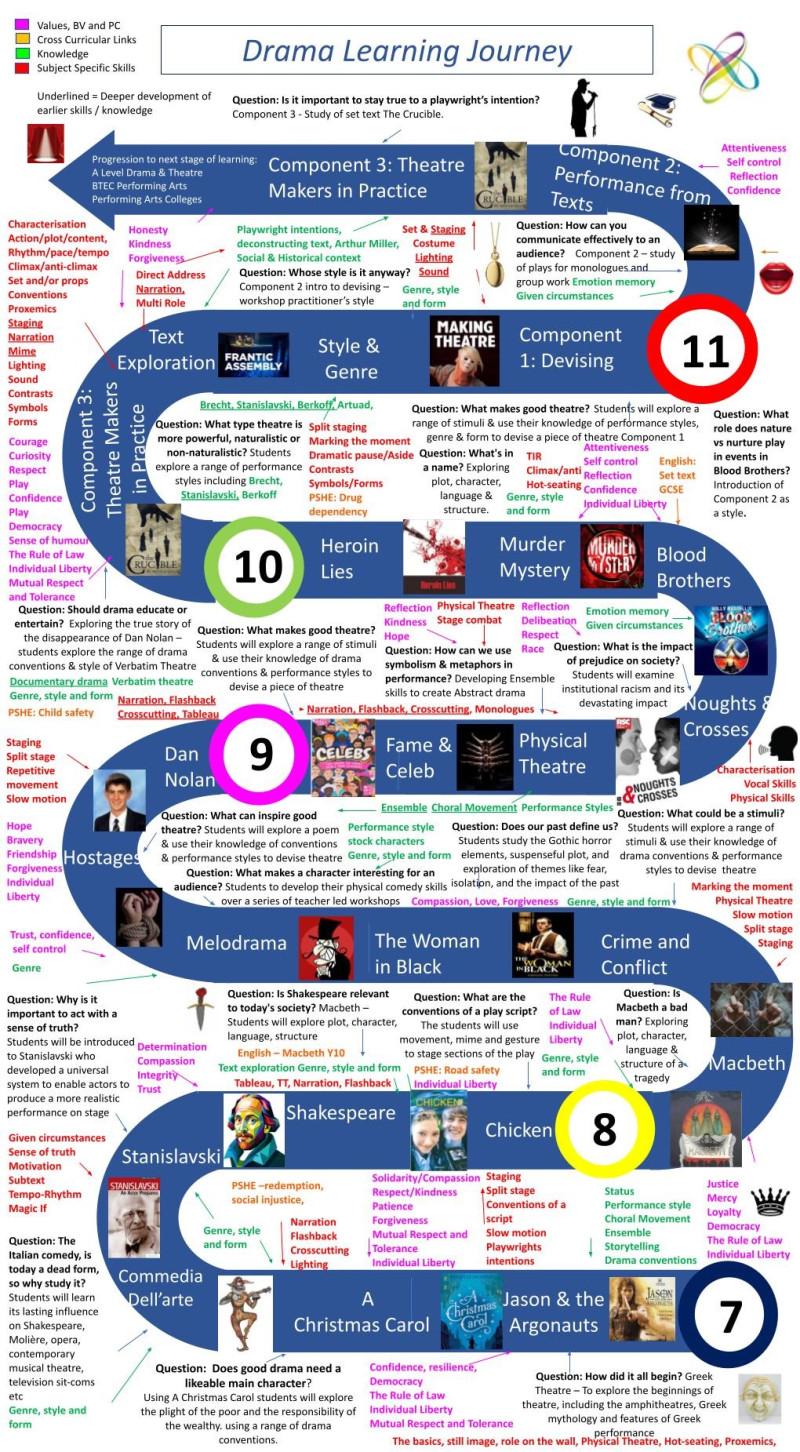
The Curriculum Narrative outlines the knowledge and skills which are introduced, developed and then mastered in each academic year. Units may be adapted and changed in order to suit the needs of individual groups depending on circumstance, ability, issues arising.
Systematic….. have sequenced our curriculum by carefully considering the order that units and skills are taught, so that students are able to build up their knowledge.
Lessons are planned… have built in knowledge retrieval and reinforcement as part of our normal lesson routines. A range of strategies are utilised including mini-whiteboards as we find it aids our students ability to recall and apply knowledge.
Links…. Ensure that all students appreciate our rich and varied dramatic heritage. We are fortunate that there are many current and relevant real world examples that we can draw on to bring our subject to life. This enables us to develop the cultural capital and raise the understanding of our students. This enables students to consider things from different standpoints.
Reading….develop reading as we know that students' ability to access the curriculum is key to their understanding. Studying extracts, plays and poems enables us to develop their reading skills and better equip them to learn. During lessons we use a range of text to allow students to speak for a variety of purposes and audiences.
Curriculum Imp
What we know…plan our curriculum to ensure regular revisiting, retrieval and reinforcement through the spiral and sequential model. We use Do Now tasks to recall prior knowledge to check learning and respond to any gaps.
We learn…use questioning, discussion, turn and talk to engage students. We provide opportunities for students to apply their learning through drama scenarios.
Our working…use I do, we do, you do to model and practice together new knowledge before students have a go on their own. We use Do Now tasks to retrieve key knowledge and teach new concepts in small chunks to help students process information.
Fluency…We support our students to develop resilience and persistence as we believe fluency arises through practice over time. Students learn best by ‘doing’ and by allowing them to experiment in a safe and positive learning environment. We use Do Now tasks to retrieve key knowledge
Downloads
In English, our vision is:
To promote a purposeful learning programme, which is inclusive and in line with the National Curriculum, in order to develop successful speakers, readers and writers.
Curriculum Aim
At Beechwood School, in English, our curriculum aim is to promote high standards of language and literacy by equipping pupils with a strong command of the spoken and written word, and to develop their love of literature through widespread reading for enjoyment.
Curriculum Intent
In English, we meet the curriculum aims of the school by following the spiral and sequencing models to allow students to develop their knowledge gradually. The curriculum across the Key Stages has been shaped in light of our students’ needs and consequently the main priorities are to effectively balance the reading and writing skills and rigorously select an engaging and inspirational range of texts and topics.
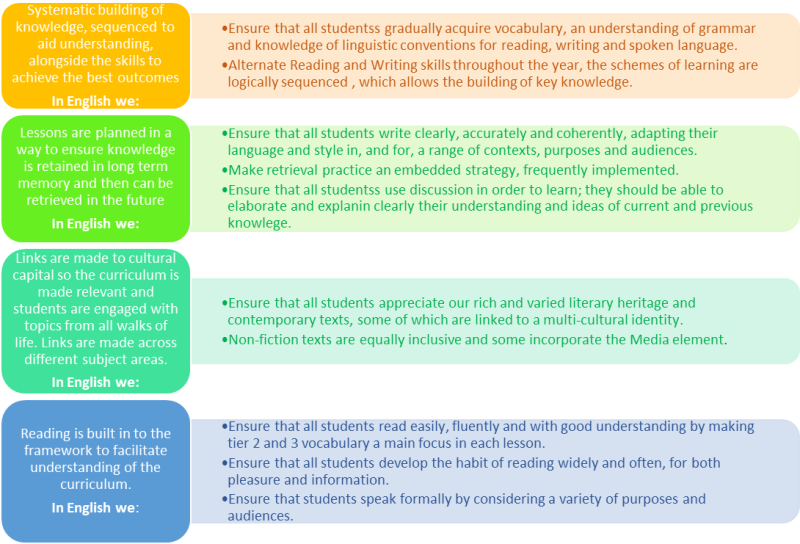
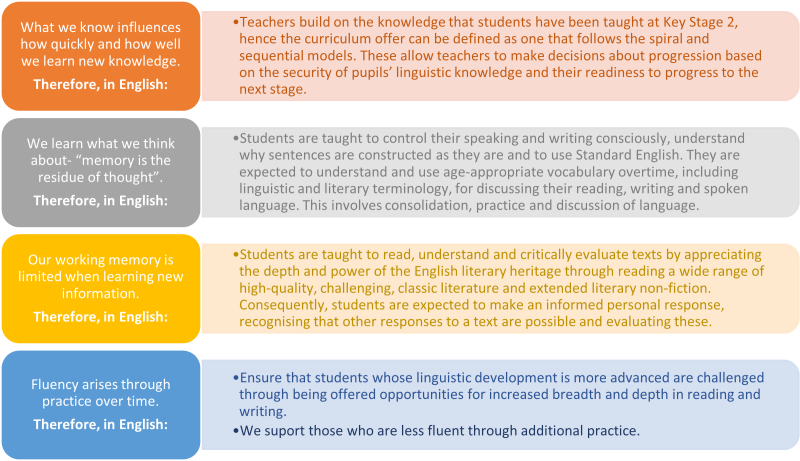
Curriculum Implementation
At Beechwood, our curriculum implementation is built on these 4 principles from cognitive science.
Downloads
Geography Vision:
The aim of our geography curriculum is to cultivate a deep understanding and appreciation of the relationship between the Earth's physical and human systems, through a knowledge rich and ambitious curriculum. Our ambition is to empower students to become informed on the complexities of the world, but are responsible global citizens.
Geography Aim:
The national curriculum forms the basis of our curriculum where we carry through 4 key themes through years 7-13 that students will study geography. We ensure that students have a developed and rich knowledge of the world and how they play apart in it. We also take inspiration from current events and the ever-changing nature of geography; students will cover a diverse and relevant curriculum, varying from how the earth began to current conflicts and how geography plays a part in this. To develop this we researched how to make our student’s responsible global citizens and used this as a baseline in everything we teach. This allows students to have a deep and informed understanding on many aspects of our earth in both human and physical.
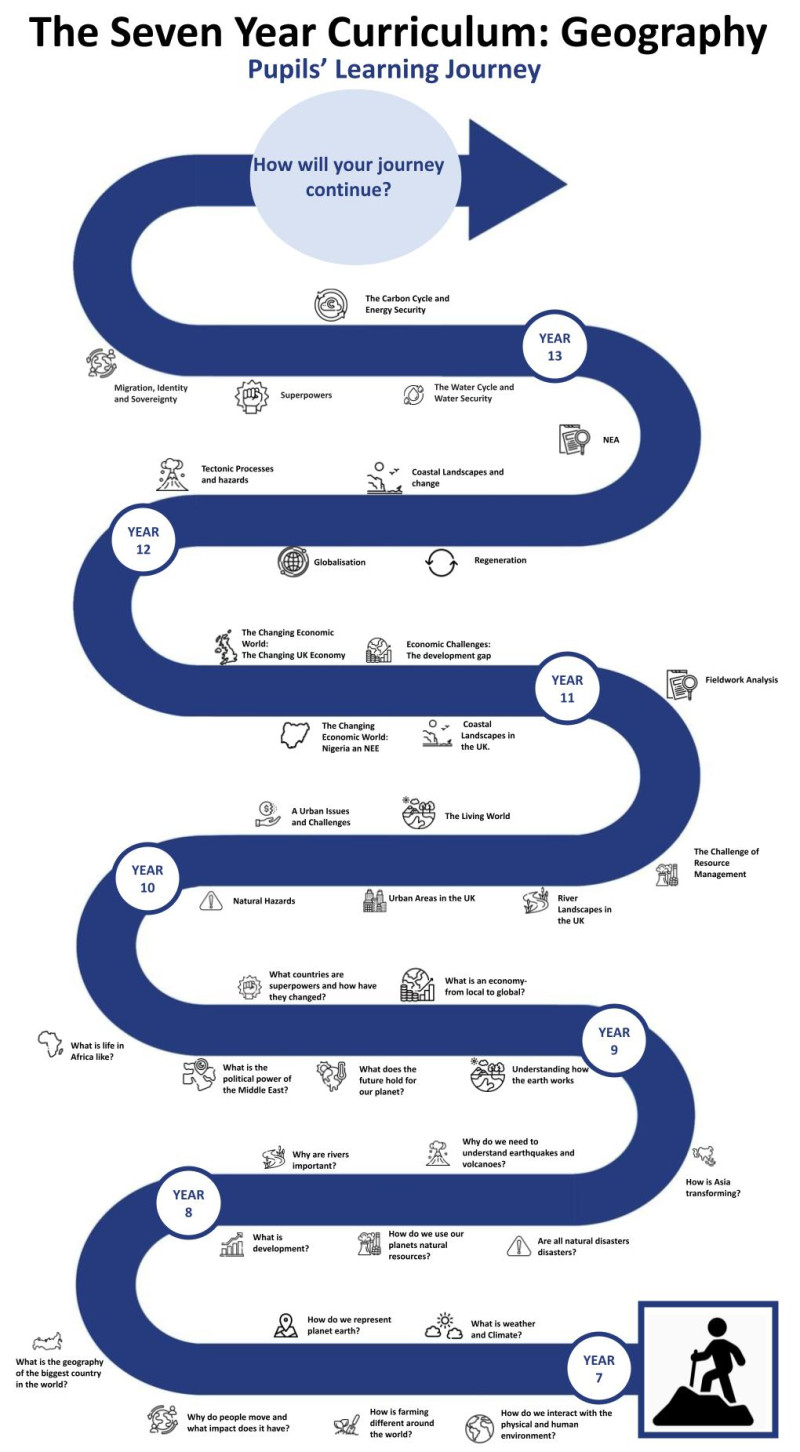
Students will set the foundations for their learning in year 7 - getting to grips with how our earth works and how we as humans have made it our own. In year 8, students develop their understanding by studying the impact we have as humans - whether that be what climate change is or understanding poverty. Moving into year 9, students will delve deeper into previous topics giving them a better understanding of our world.
In Geography our vision is:
Our ambition is to empower students to become informed, responsible global citizens who are informed on the complexities of the world, but are responsible global citizens.
Curriculum Aim
The aim of our geography curriculum is to cultivate a deep understanding and appreciation of the relationship between the Earth's physical and human systems, through a knowledge rich and ambitious curriculum
Curriculum Intent
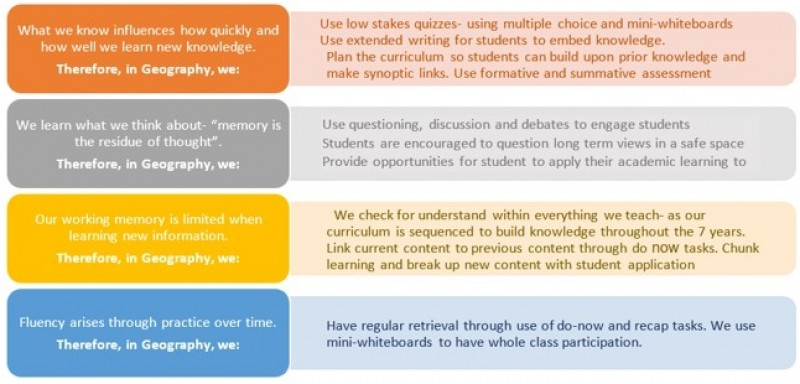
In Geography, we meet the curriculum aims of the school by:
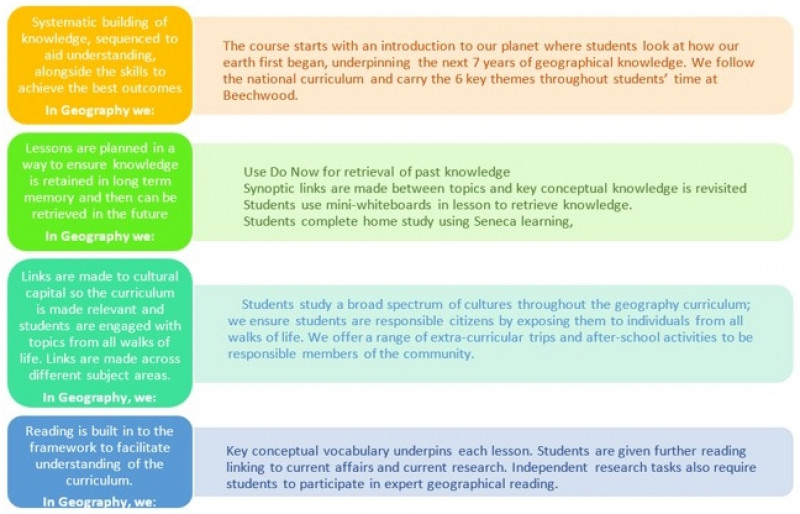
Curriculum Implementation
At Beechwood, our curriculum implementation is built on these 4 principles from cognitive science.
Downloads
History Vision:
The aim of our history curriculum is to foster a deep understanding and appreciation of the past, equipping students with the knowledge and skills to critically analyse historical events, their causes, and their consequences through an ambitious curriculum. By engaging with diverse perspectives and sources, students will develop empathy, tolerance, and respect for different cultures, societies, and historical narratives. Our curriculum aims to empower students to become active and informed citizens, capable of contributing positively to society and making informed decisions based on a comprehensive understanding of the past.
History Aim:
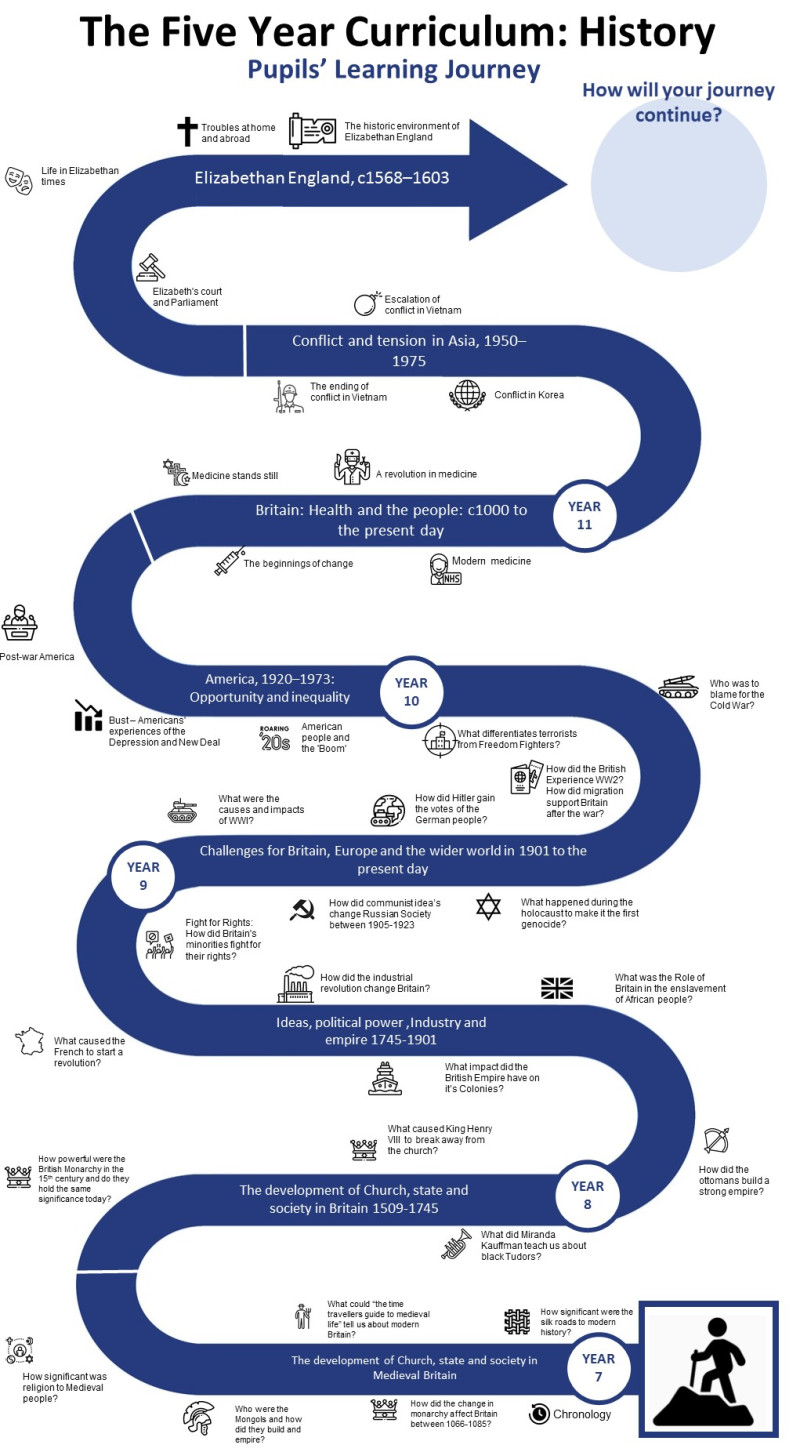
Our history curriculum is designed in accordance with the guidelines set forth by the National Curriculum, ensuring that students acquire a broad and balanced understanding of British and world history. In year 7, we focus on the development of Church, state and society in Medieval Britain 1066-1509; looking at women's stories and the stories of minorities within Britain, as well as traditional history.
In year 8, we focus on ideas, political power, industry and empire: Britain, 1745-1901; looking at how empires grew globally and their impact on citizens.
In year 9, we look at challenges for Britain, Europe and the wider world 1901 to the present day; looking at world wars and decolonisation. We also have a deep focus on how different individuals fought hard for their rights and what is still to be done today. We focus on following the key stages and objectives outlined in the National Curriculum, covering a range of historical periods, themes, and concepts.
Throughout our history curriculum we have moved towards a blended teaching approach where students study history within its themes as opposed to chronologically. This informed approach allows students to relate history from many years ago to the modern day; for example the Crusades which began in 1095 giving context to the current conflict in Israel and Gaza.
We have informed our curriculum with experts in the field to ensure that our students receive a knowledge rich and ambitious curriculum which is both diverse and deep in understanding. By blending traditional and modern pedagogical approaches, we aim to create a dynamic and inclusive learning environment that inspires curiosity, fosters critical thinking, and promotes academic excellence in the study of history.
In History our vision is:
The aim of our history curriculum is to foster a deep understanding and appreciation of the past, equipping students with the knowledge and skills to critically analyse historical events, their causes, and their consequences through an ambitious curriculum.
Curriculum Aim
Our curriculum aims to empower students to become active and informed citizens, capable of contributing positively to society and making informed decisions based on a comprehensive understanding of the past.
Curriculum Intent
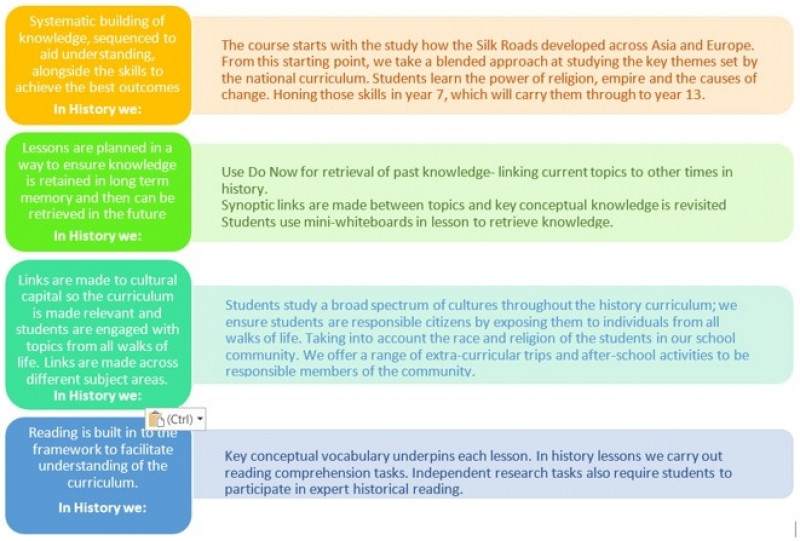
In History, we meet the curriculum aims of the school by:
Curriculum Implementation
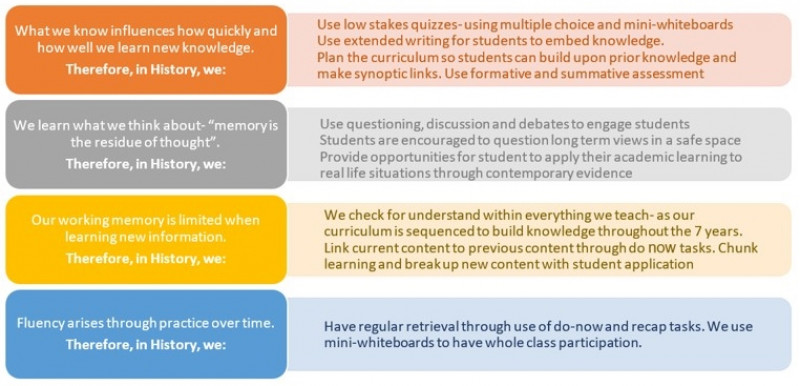
At Beechwood, our curriculum implementation is built on these 4 principles from cognitive science.
Downloads
In Maths, our vision is:
To develop lifelong learners by motivating and promoting a positive attitude towards the learning of maths in order to equip students with the tools they need across the curriculum and beyond the classroom.
Curriculum Aim
At Beechwood School, in Maths our curriculum aim, in line with the national curriculum, is to develop fluency, mathematical reasoning and problem solving, we ensure that these are embedded throughout our curriculum planning throughout Key Stage 3, 4 and 5.
Curriculum Intent
In Maths we meet the curriculum aims of the school by:

Curriculum Implementation
At Beechwood, our curriculum implementation is built on these 4 principles from cognitive science.

Downloads
- Maths Curriculum End Points Stage 6
- Maths Curriculum Endpoints - Year 7
- Maths Curriculum Endpoints - Year 8
- Maths Curriculum Endpoints - Year 9
- Maths Curriculum Endpoints - Year 10 (Foundation)
- Maths Curriculum Endpoints - Year 10 (Higher)
- Maths Curriculum Endpoints - Year 11 (Foundation)
- Maths Curriculum Endpoints - Year 11 (Higher)
Curriculum Aim
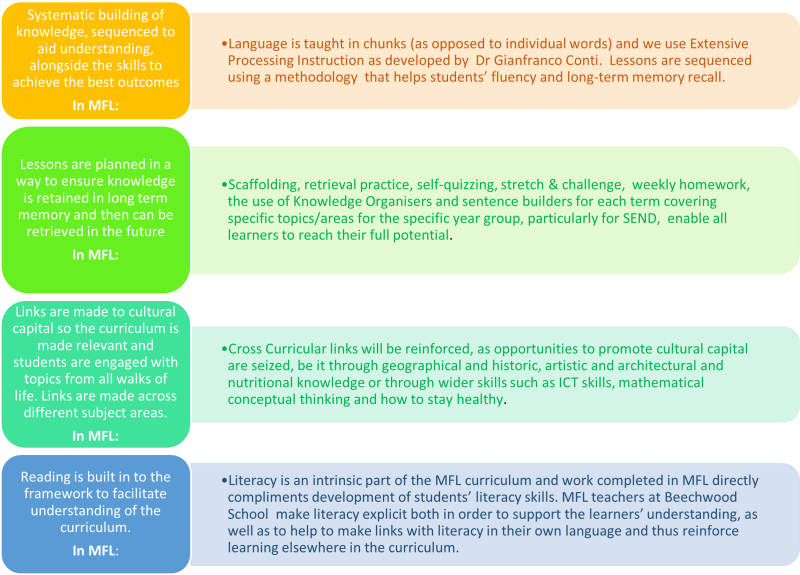
At Beechwood School, in MFL, our curriculum aim is for our students to experience a challenging curriculum, rich in variety and diversity, underpinned by our whole school values of Kindness, Excellence and Respect.
In the MFL Department, we reflect these values in our approach to Teaching & Learning and understand that underpinning all of this is:
· High expectations & mutual respect for all to become the very best that they can be.
· Everyone can be successful and strive for excellence in language learning regardless of their starting point, ability, gender, race, or background.
· The belief in the power of kindness & ambition to change lives for the better and to prepare them for success in life.
Curriculum Intent
In the MFL Department, the focus of our curriculum is heavily directed to development of students’ communication skills, self-efficacy, strong and durable retention of language, independence, autonomy and to encourage the lifelong learning of languages; Languages are like keys, they open doors to: Culture and Tradition, History, Politics, Art and to people!
Through the 3 pillars of language progression – Phonology, Vocabulary and Grammar, students will gain a strong phonetic knowledge to enable them to converse confidently (and pronounce new vocabulary) and a reinforcement of many literacy skills from their first language.
Our ambitious vision for our Language Learners is that they complete their secondary school experience with an in-depth understanding of how language works, and that they become equipped with a range of skills and knowledge to continue to improve their own language, as well as to develop their skills in one or more foreign languages as they progress on their journey to adulthood.
Music development plan summary:
Beechwood School
Overview
Detail |
Information |
| Academic year that this summary covers | 2024/25 |
| Date this summary was published | September 2024 |
| Date this summary will be reviewed | July 2025 |
| Name of the school music lead | Mr Alec Harris |
| Name of school leadership team member with responsibility for music (if different) | Mrs Dawn Dadak |
| Name of local music hub | Slough Music Service |
| Name of other music education organisation(s) (if partnership in place) | Slough Music Service |
Part A: Curriculum music
Curriculum aims & pedagogy: The aim of The Music Department is to enable students to strive for academic excellence in theoretical and practical knowledge that enables them to develop the knowledge and skills of collaboration, confidence, communication, resilience and dedication towards music education. They will explore themes and topics through a variety of genres to develop their cultural capital. We strive to create a safe, happy, inspiring learning environment encouraging and enabling all students to develop an understanding of both themselves and the world they live in. Whilst not everyone will become a performer, we strive to develop key employability and transferable skills, signposting these to students to ensure their complete understanding. The Arts builds confidence and teaches students a huge range of transferable skills; thus, opening up many career opportunities.
The department is led by Dawn Dadak, head of Performing Arts. Music is delivered by Alec Harris, a music specialist who is a highly qualified and experienced teacher. In Key Stage 3, students have two lessons of Music in a two-week timetable. Music is a growing subject at Beechwood, as such, we are hoping to offer GCSE Music to students 2025/2026.
KS3 Music Curriculum Plan
Year 7
Term 1
Elements of music through performance
Key Skills and Concepts
- Understand and recognise the Elements of Music: PITCH, TEMPO, DYNAMICS, DURATION, TEXTURE, TIMBRE, RHYTHM, BEAT / PULSE.
- Draw on the Elements of Music as a resource when composing, creating and improvising
- Use the Elements of Music effectively when performing and singing.
- Recognise the Elements of Music when listening to and appraising music from different times and different places.
Assessment:
- Do now retrieval tasks
- Teacher monitoring every lesson and a mark given to the students based on the skills they are demonstrating
- Class and group performances throughout the unit which will be video
- Assessment of understanding elements of music which is set for homework
Term 2
I’ve Got Rhythm
Key Skills & Concepts
- Develop a feeling for and an awareness of a regular pulse in music from different times and places.
- Distinguish between pulse/beat and rhythm.
- Develop an understanding of note values in terms of duration, bars and simple time signatures
- Application of skills through performance
Assessment:
- Do now retrieval tasks
- Teacher monitoring every lesson and a mark given to the students based on the skills they are demonstrating
- Class and group performances throughout the unit which will be videod
- Composition task for students to demonstrate understanding practically which will be assessed
- Assessment of understanding elements of music which is set for homework
Term 3
Keyboard skills - Introduction to note reading
Key Skills & Concepts
- Understand how the classroom keyboard is used and played through developing basic keyboard techniques
- Practising pieces of keyboard music to build skills and understanding of reading music and playing an instrument using correct posture, fingering and accuracy of pitch and rhythm
- Further developing understanding of pitch and rhythm through learning to read treble clef notation
- EXT: Developing own instrumental skills and improving music theory knowledge
Assessment:
- Do now retrieval tasks
- Students self review every lesson using the ‘I can…’ grid in their booklets
- Teacher monitoring every lesson and a mark given to the students based on the skills they are demonstrating
- Final performance of a piece to the teacher who can then assess accuracy and fluency in performance
Term 4
Instruments of the orchestra
Key Skills & Concepts
- Develop an understanding of musical instruments and how they are played, the families/sections, construction , different sound production methods and characteristic timbres/sonorities.
- Improve instrument recognition and the role of the instrument in an orchestra
- Perform using orchestral tones/voices/sounds from keyboards as part of a ‘class orchestra’ with an awareness of the experience of ‘performing together’ as an ensemble and the roles of different instrumental parts and textural layers on the music as a whole.
Assessment:
- Do now retrieval tasks
- Weekly listening tasks identifying instruments of the orchestra
- Knowledge and understanding assessed homework - exit ticket style
- Monitoring of rehearsal and learning time
- Recorded mid-point and final performance
Term 5
Introduction to Band Skills: Ukulele
Key Skills & Concepts
- To develop instrumental skills on the ukulele
- To understand what a chord is and how to play a chord on a ukulele
- To develop rehearsal skills using the Learn to Play framework
- To improve timing when playing as part of a group
- To demonstrate successful performance skills on the ukulele
Assessment:
- Do now retrieval tasks
- Monitoring of students progress throughout the unit of work
- Mid-point performance assessment
- Assessment of knowledge and understanding through homework task
- Final performance assessment
Term 6
Soundscapes using Music Technology
Key Skills and Concepts
- Demonstrate understanding of the Elements of Music: PITCH, TEMPO, DYNAMICS, DURATION, TEXTURE, TIMBRE or SONORITY, ARTICULATION, SILENCE.
- Draw on the Elements of Music as a resource when composing, creating and improvising
- Recognise the Elements of Music when listening to and appraising music from different times and different places.
- Develop skills in using music technology
Assessment
- Do now retrieval tasks
- Continuous monitoring of students composition work
- Elements of music assessment homework task
- Mid-point review of composition work
- Final hand in of composition work
Year 8
Term 1
Exploring Rhythm and Pulse through Samba
Key Skills & Concepts
- Develop understanding of the importance of rhythm in music
- Understand how instruments, structures and textures are used in Samba
- Perform as part of a larger ensemble understanding key roles of performers and different instruments and the relationship between these and the effect this has on the music
- Use rhythmic features such as ostinato, cyclic rhythms, polyrhythms, call and response and syncopation when performing and improvising
Assessment:
- Do now retrieval tasks
- Small assessment tasks throughout the unit
- Weekly monitoring and verbal feedback
- Mid-point performance review and feedback
- Mid-point elements of music assessment for homework
- Final performances with teacher assessment and student reviews
Term 2
Advanced Keyboard - simple chords and melodies
Key Skills & Concepts
- Recap how the classroom keyboard is used and played
- Practising pieces of keyboard music to build skills and understanding of reading music and playing an instrument using correct posture, fingering and accuracy of pitch and rhythm
- Understand the importance of “warming-up” before playing a keyboard or piano
- Understand what a chord is and how to play a chord
- Learn how to read bass clef
- Develop solo performance skills
Assessment:
- Do now retrieval tasks
- Mid-point elements of music assessment for homework
- Regular monitoring and regular verbal feedback
- Video of performance and final assessment
Term 3
Variation Form
Key Skills & Concepts
- To develop a knowledge and understanding of how the Elements of Music can be used and manipulated as a basic form of musical variation to an existing theme or melody
- Know, understand, and use other musical devices that can be changed or added to, to provide musical variation to an existing theme or melody
- Understand Variation Form as a type of musical Form and Structure
- Develop listening skills and ability to identify specific musical features
- To develop compositional skills
Assessment:
- Do now retrieval tasks
- Review of learning end of lesson tasks
- Monitoring of progress in composition ]
- Mid-point understanding the elements of music assessment - homework task
- Final assessment of variations
Term 4
Off-beat: Exploring Reggae (Ukulele Project)
Key Skills & Concepts
- To recognise the stylistic conventions of Reggae music
- How chords contribute to the texture of a song
- To understand the difference between primary and secondary chords
- To recognise the key features of a Reggae bass line
- To understand syncopation and how it is used in Reggae music
- To identify the different layers that make up Reggae music
- To develop ukulele skills through learning how to change between chords and how to play a bass riff and melodic hook
Assessment:
- Do now retrieval tasks
- Review of learning end of lesson tasks
- Monitoring of progress in performing
- Mid-point understanding the elements of music assessment - homework task
- Final assessment of arrangement of Reggae song
Terms 5 and 6
Music technology focus - Music for Video Games
Key Skills and Concepts
- Develop confidence in using music technology to compose music
- Understand the various ways in which music is used within a range of computer and video games from different times.
- Understand, describe and use common compositional features used in computer and video game music.
- Understand how to vary, adapt and change a melody (character theme) for different atmospheres/scenarios.
- Understand the importance of sound effects and how these are used at certain cues to enhance gameplay within a computer or video game.
Assessment
- Do now retrieval tasks
- Mid-point assessment of understanding the elements of music
- Regular monitoring and feedback throughout the unit
- Final assessment and feedback of compositions and skills in using the technology
Year 9
Term 1
The Blues: Developing keyboard skills
Key Skills & Concepts
- Know how Chords and Triads are performed, notated, and used in Blues within a 12-bar Blues Chord Sequence
- Know, recognise, and perform Chords I, I7, IV, IV7, V & V7 in different ways e.g., as a Walking Bass Line
- Understand and demonstrate what makes an “effective” improvisation e.g., using the notes of the Blues Scale
- Understand how lyrics are structured over the 12 bar blues chord sequence
- Compose in a Blues style demonstrated understanding of the typical features
Assessment:
- Do now retrieval tasks
- Regular monitoring of students work and feedback
- Recordings of students work for feedback
- Mid-point assessment of the Elements of Music
- Final assessment of Blues piece
Term 2
Minimalism
Key Skills & Concepts
- Develop understanding of simple and compound time signatures
- Understand that twentieth century music consisted of many different types, styles, movements and genres
- Understand and demonstrate how minimalist composers develop pieces from small starting points
- Know and demonstrate the compositional and serialist techniques used by expressionist composers
- Manipulate motifs, cells and note/tone rows using a variety of musical development techniques
Assessment:
- Do now retrieval tasks
- Regular monitoring of composition tasks
- Verbal feedback on a regular basis
- Mid-point assessment demonstrating understanding of elements of music specific to minimalism
- Final assessment of composition work
Terms 3 and 4
Film Music Composition using Music Technology
Key Skills & Concepts
- How music can enhance the visual images and dramatic impact of film and can reflect the emotional and narrative messages of the drama
- How timing is a crucial factor in the composition and performance of music for film
- How film music can change the viewer’s interpretation of a scene
- Exploration of a range of film music composers
- Develop listening skills through identification of typical film music techniques
- How to create an effective musical narrative for a film scene, using appropriate techniques to create an intended effect
Assessment:
- Do now retrieval tasks
- Mini assessment tasks demonstrating understanding of key compositional features sued in film music
- Mid-point assessment demonstrating understanding of elements of music specific to film music
- Final composition project assessment
Terms 5 and 6
Band Skills: Musical Futures
Key Skills and Concepts
- To know the Terminology Associated with the Instrument
- To be able to follow instructions
- To demonstrate secure ability to play an instrument
- To develop ensemble skills
- To learn and understand what it means to be a Musician
- To follow written notation
Assessment
- Do now retrieval tasks
- Regular monitoring of skills development as suggested by Musical Futures
- Regular verbal feedback
- Self-assessment through weekly WWW and EBI setting
- Mid-point performance assessment
- Mid-point elements of music assessment to complete for homework
- Final performance assessment
Extension unit: Introduction to songwriting (4 chord hits)
Key Skills and Concepts
- Understand how popular songs have mass appeal across all age ranges and in a variety of contexts.
- Understand the importance of structure in popular songs.
- Understand the importance of a memorable melody in a popular song.
- Understand ways of describing melodic movement and range
Assessment:
- Do now retrieval tasks
- Listening assessments throughout the unit
- Regular feedback on composition
- Mid-point elements of music assessment for homework
- Final assessment of pop song compositions
Part B: Co-curricular music
Beyond our class teaching, students are given the opportunity to expand their musical experience by attending extra-curricular within school and Slough Music Service. Enrichment activities are also encouraged and we are hoping to increase such events during our next academic year.
At school we currently offer the following activities:
- School Choir
- Recorder Club
Instrumental provision by Slough Music Service is:
- Strings: Violin, Viola, Cello, Guitar: acoustic and electric
- Woodwind: Flute, Recorder, Clarinet and Saxophone
- Piano and Keyboard
- Drums
Part C: Musical experiences
This is about all the other musical events and opportunities that we organise, such as singing in assembly, concerts and shows, and trips to professional concerts.
- As the students' confidence increases, we are planning on including regular events such as singing in assembly, musical performances, concerts and shows at the school, and trips to concerts outside of the school. The choir have already sung at a celebration evening, and In December the choir is singing at a community Christmas celebration.
In the future
This is about what the school is planning for subsequent years.
Music is a growing subject at Beechwood, as such, we are hoping to offer Music at Key Stage 4 to students 2026/2027.
Offer peripatetic lessons.
Offer cultural musical experiences to disadvantaged students.
Beechwood has been awarded the School Games GOLD Mark Award 2025/26 –
the first time the school has achieved Gold in the award’s history
Beechwood becomes first Slough accredited LTA school for the Lawn Tennis Association
In Physical Education our vision is:
At Beechwood School, in PE our curriculum vision is to develop an all-round, lifelong, love for physical activity. We Respect all, we believe all students can achieve Excellence regardless of their prior attainment and we expect Kindness from all pupils.
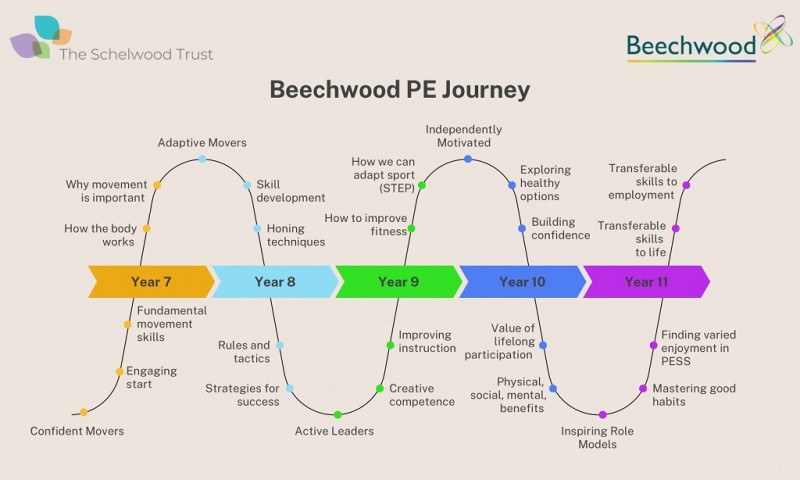
Curriculum Aim
In the PE department, our curriculum is ambitious for all students. Each year, all students are given the opportunity to take part in a wide variety of disciplines, both individual and team based to allow them to find an activity they enjoy and will continue to engage with in the future either through academic study of PE or through an active, healthy lifestyle.
All pupils aim for the same learning outcomes, the only difference between groups is the number of scaffolds. We teach to the top and scaffold along. We model knowledge to all students, engage in metacognitive talk and input disciplinary literacy across both core and academic PE with responsible citizens created at the end of their PE journey.
Curriculum Intent
In PE we meet the curriculum aims of the school by:

Curriculum Implementation
At Beechwood, our curriculum implementation is built on these 4 principles from cognitive science.

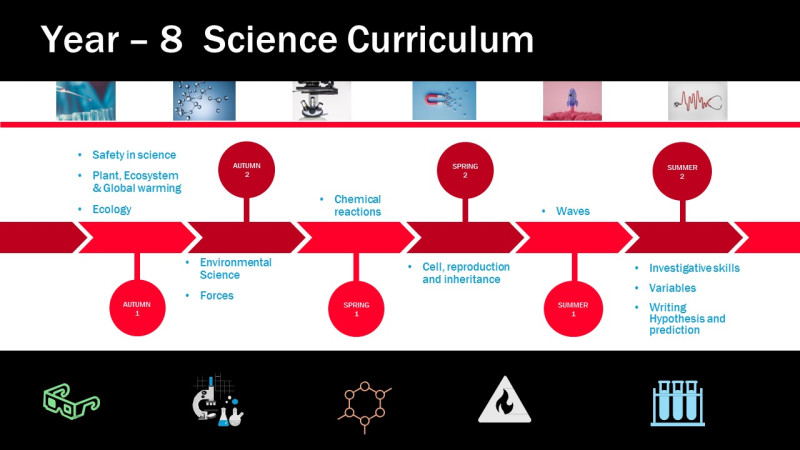
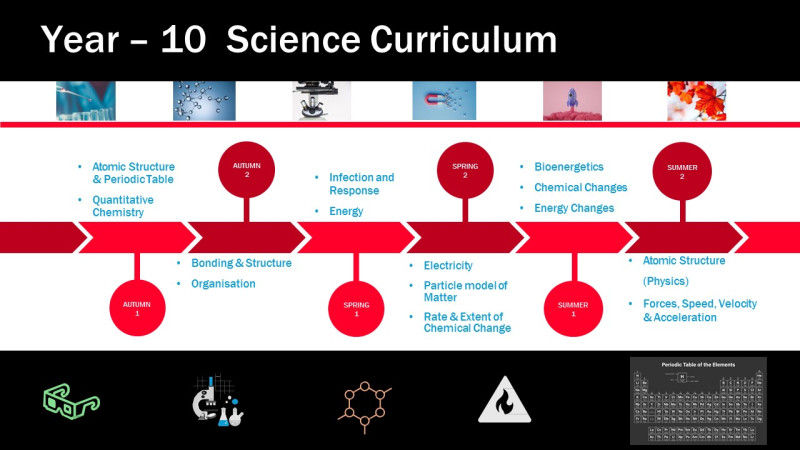
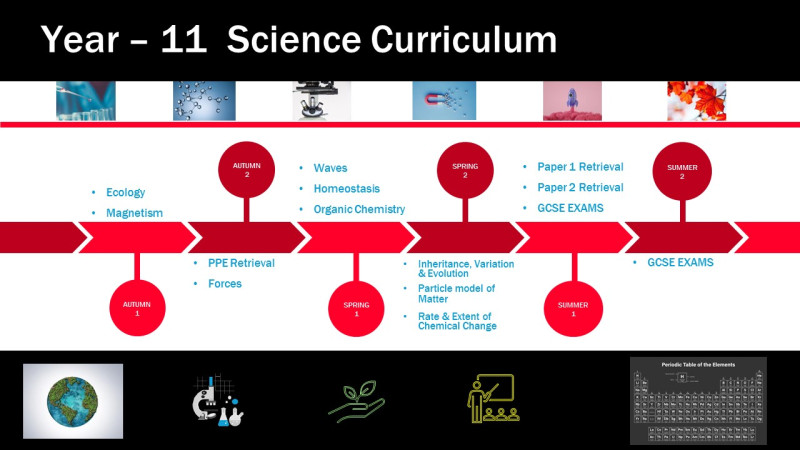
In Science our vision is:
To give students the knowledge they need to understand the amazing universe around them, to understand why things happen the way they do and to be able contribute to the next generation of scientific developments.
Curriculum Aim
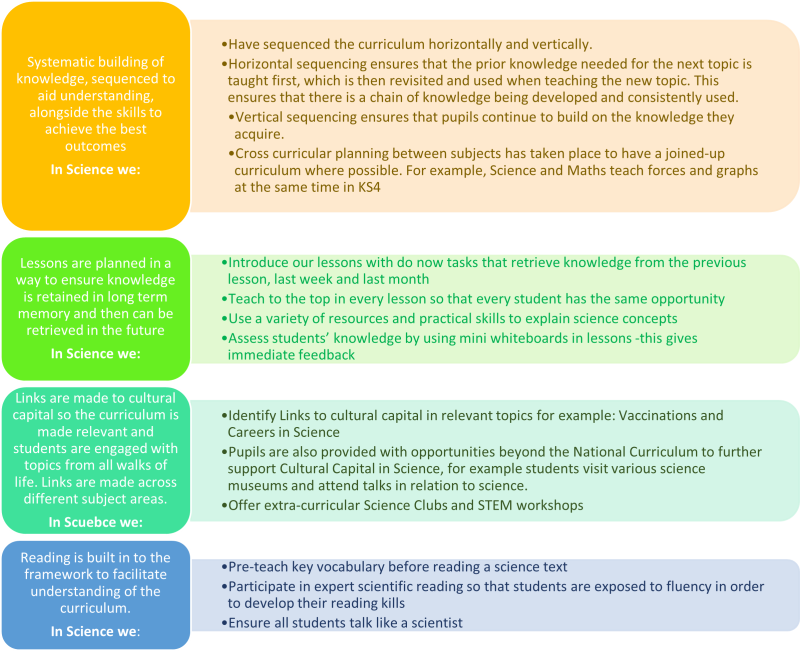
At Beechwood School, in Science, our curriculum aim is to ensure pupils build a strong network of knowledge and facts and be able to retrieve them fluently. To be able to use their knowledge in a wide range of scenarios and to speak and write like a scientist. To become a strong reader in science, so they can access texts outside of the curriculum and have the outcomes that give them the choice of studying science beyond beechwood.
Curriculum Intent
In Science we meet the curriculum aims of the school by
Curriculum Implementation
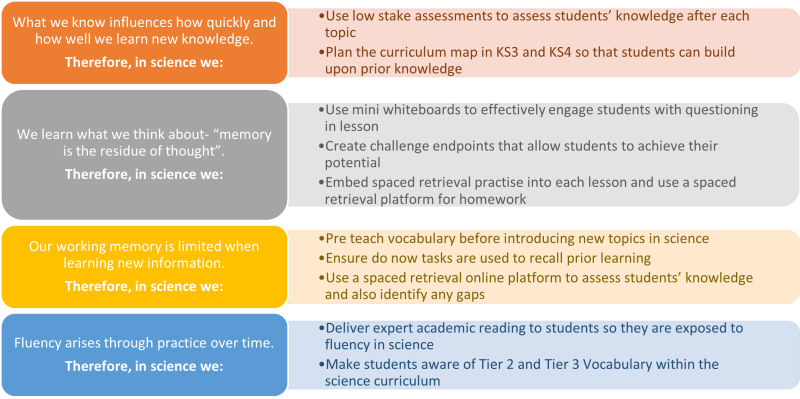
At Beechwood, our curriculum implementation is built on these 4 principles from cognitive science.

Downloads
In Sociology our vision is:
To give students the opportunity to delve deeper into society and understand how it functions through critically examining ways of life.
Curriculum Aim
At Beechwood School, in Sociology, our curriculum aim is to create young Sociologists who evaluate society around them and allow them to gain an appreciation of how and why society works in the way that it does.
Curriculum Intent
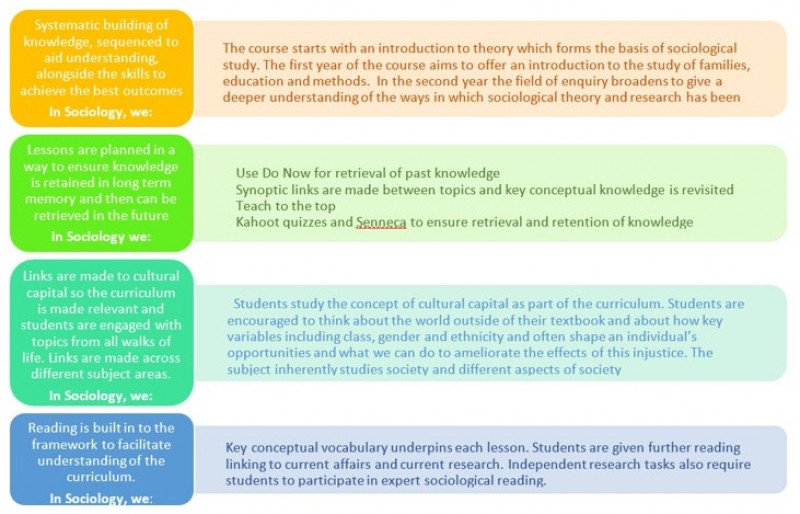
In Sociology, we meet the curriculum aims of the school by:
Curriculum Implementation
At Beechwood, our curriculum implementation is built on these 4 principles from cognitive science.