
Five to Thrive and Emotion Coaching
Five to Thrive and Emotion Coaching - a summary for Parents/Carers
All staff had training delivered in January and July about Five to Thrive and Emotion Coaching. Five to Thrive was designed initially as a therapy tool for children who have experienced attachment based trauma, but the 5 steps provide clear steps for all staff to follow when dealing with our students.
The benefits of the training were built upon some clear principles:
- Attachment is a need for connection. We all have attachment needs. We need these connecting relationships all throughout our lives.
- The benefits of building resilience allow us to respond more effectively and recover more quickly following challenges in our lives.
- Stress is part of everyday life, but when we experience toxic stress we shut down and are unable to act as we would like at work and with friends and family.
- Toxic stress is the signal to the brain that we are under threat – it triggers the threat response, which then produces a burst of stress hormones to give us strength and speed (fight or flight) and if this doesn’t work to remove the threat it then closes down the nervous system (freeze). Prolonged threat or prolonged toxic stress leaves us alternating between fight or flight (hyperarousal) and freeze (dissociation).
- Evidence suggests that 1:3 of our children have experienced toxic stress during childhood and 1:12 of people have at some stage met the threshold for Post Traumatic Stress Disorder (PTDS) which will affect our ability to function in everyday life. Trauma is therefore not rare, and these figures were published in 2019 before the Coronavirus pandemic.
- Repeated trauma can impair development as the pathways that connect the brain become damaged.
- Adverse Childhood Experiences (ACEs) can make us vulnerable which may lead to stress.
- It is possible to recover from the impact of trauma which makes us more resilient to toxic stress in the future.
- When we become too stressed and anxious we ‘flip our lid’ which makes it almost impossible for us to react rationally unless we have someone to coregulate with and bring our stress levels down. This link explains the premise behind getting ‘the flipped lid back on’. https://youtu.be/gm9CIJ74Oxw
- The more connections and relationships that children have with adults in school will allow them to regulate, get the lid back on and continue with learning.
In summary
- Noticing and valuing connection and compassion are key to building resilient, compassionate communities
- Five to Thrive is a model, an approach and a framework to help you do this
- Behaviour is the communication of a need, often driven by stress or trauma – no matter how old we are!
- We all need compassionate connection when dysregulated, particularly children
- We are all vulnerable and all resilient
- Connected, compassionate relationships support our resilience!
- Every interaction is an opportunity to make a difference…
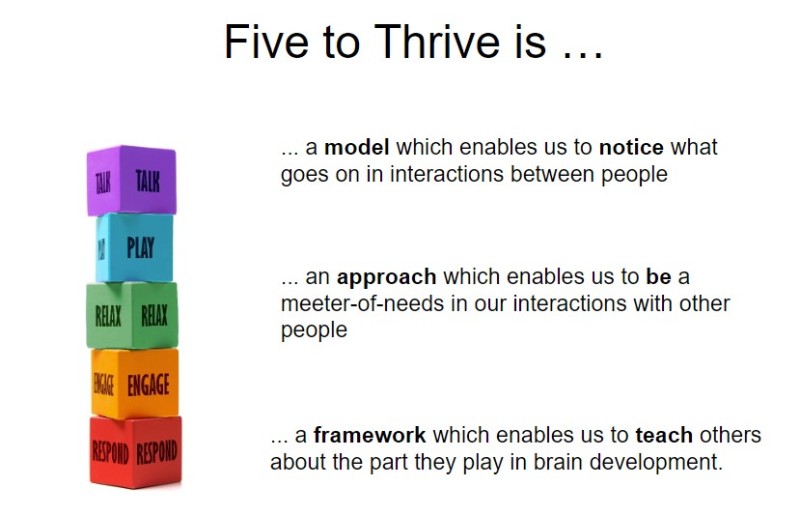
Respond: We accept that someone is not in control of their emotions
Engage: We make a link, a connection with the student, usually by talking quietly and getting close to the person.
Relax : This transforms the emotional trauma, the lid on the unregulated emotions is now back on.
Play: this is not physical play, but can be a joke, comment, or a non verbal action which allows the person to connect with someone.
For many children these stages can happen within seconds. It is only when connections are made and the ‘lid in back on’ that people are then able to talk and make sense of how they have been feeling and behaving.
Talk: activating the rational part of the brain
When students are ready to talk with an adult, we then need to think about how we do this, which is where emotion coaching comes in.
At Beechwood School we are fortunate enough to have Hannah Brooks working with us a day/week. Hannah is a trained Educational Psychologist and provides support for both staff and students in a wide variety of matters. This includes completing individual work with students including cognitive assessments of ability as well as social emotional regulation work. Hannah also supports staff in surgeries where individual students are discussed and support plans created. She also delivers training for staff including: Five toThrive, Emotion Coaching, ASD training and more.
